Silver Nickels: Their History And Current Value
World War II caused the United States and its citizens to ration certain materials with the purpose of keeping around important resources for winning the war — such as artillery.
The United States Treasury and the U.S. Mint followed suit.
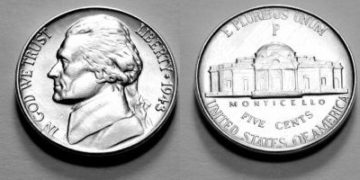
While most people are aware of the steel Lincoln pennies which were produced in 1943, few people seem to know that the silver Jefferson nickels also spent a short period of time being produced under a special metal composition issue.
With nickel an important military material, the United States Congress required the U.S. Mint to begin striking nickels from a composition of copper (56%), silver (35%), and manganese (9%).
The silver Jefferson five-cent coin composition went into production on October 8, 1942 — just months before the metallic profile of Lincoln pennies changed to steel in 1943 to help ration copper for war ammunitions.
As the value of silver has risen over the past several decades, so has the demand for, interest in, and value of wartime nickels.
Here’s more about those silver nickels…
What’s So Special About Jefferson Wartime Nickels?
Since the U.S. Mint had already begun striking 1942 nickels in the usual 75% copper and 25% nickel composition, the use of the copper / silver / manganese alloy started late in 1942.
This special composition would last the duration of World War II thereafter — right on through 1945.
So-called “wartime nickels” (as they are typically called by collectors and coin dealers) are unique in a number of ways — most notably, their:
- Metal Composition
- Mintmarks
- Values
These coins are highly sought after as collectibles!
Ironically, of course, there is no nickel in silver war nickels. Yet, most people still refer to the 1942-1945 silver 5-cent pieces as nickels anyway.
Wartime nickels mark the only time that U.S. nickels were made of silver.
Mintmarks On Wartime Silver Nickels
Numismatically, one of the most important points to make about these silver nickels is the fact that wartime nickels represent an important “first” in United States coinage history.
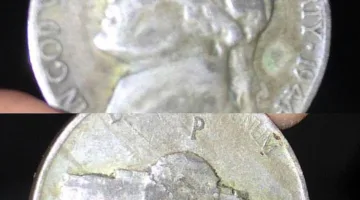
Silver nickels are the first U.S. coins to bear a “P” mintmark (“P” refers to the Philadelphia Mint):
- Up until 1942, Philadelphia-minted coins never bore a mintmark. Philadelphia has always been the “main” U.S. Mint (or the U.S. Mint’s headquarters, to use modern corporate lingo), and no mintmark was attributed to those coins.
- After 1945 (the end of the silver war nickels period), U.S. coins would not again bear a “P” mintmark until 1979.
Another important issue to note about silver nickels and their mintmarks is the physical size of the mintmark:
- The silver war nickel mintmarks are huge — virtually unable to be missed by the naked eye.
- While some people have relative difficulty finding mintmarks on other U.S. coins, the same cannot be said of wartime nickels and their mintmarks.
- In fact, finding the large mintmarks over the dome of Monticello on the reverse of the coin is the easiest way to tell silver nickels apart from “regular” nickels!
With the rise in silver prices during the mid 1960s, the heavy spike in silver bullion values during 1979-1980, and recent inclines in the price of silver, collectors and investors alike have been paying more attention to this run of 11 different silver nickels which were produced during the height of World War II.
The 11 dates and mintmarks for silver war nickels are:
- 1942, Philadelphia (P)
- 1942, San Francisco (S)
- 1943, Philadelphia (P)
- 1943, Denver (D)
- 1943, San Francisco (S)
- 1944, Philadelphia (P)
- 1944, Denver (D)
- 1944, San Francisco (S)
- 1945, Philadelphia (P)
- 1945, Denver (D)
- 1945, San Francisco (S)
How Much Are Silver War Nickels Worth?
Naturally, you’re probably wondering how much your wartime Jefferson silver nickels are worth today.
While it’s important to keep in mind that most coins need to be physically examined and appraised by a professional coin dealer in order to determine their full value, most silver nickels in worn condition will be more or less worth their “spot” price. That is, the amount of money the metal inside the coin is worth. Since silver prices fluctuate hourly (yes, bullion can be and is a highly volatile market), it is wise to refer to a current silver price chart.
According to this silver pricing calculator:
- If silver values are $15 per ounce, then the silver in a wartime Jefferson nickel is 84 cents.
- If silver is $16, then the silver value of a wartime nickel is 90 cents.
- With prices at $17, a single war nickel contains 96 cents of silver.
If you happen to have a silver Jefferson nickel that is uncirculated or contains errors, then your coin will be worth considerably more than the spot price.
Here’s an example of how much Jefferson silver nickels are worth, based on today’s silver prices:
- 1942-P nickel — $1.25 and up
- 1942-S nickel — $1.25 and up
- 1943-P nickel— $1.25
- 1943-P, 3/2 nickel — $40 and up
- 1943-P, Doubled Eye nickel — $20 and up
- 1943-D nickel — $1.25 and up
- 1943-S nickel — $1.25 and up
- 1944-P nickel — $1.25 and up
- 1944-D nickel — $1.25 and up
- 1944-S nickel — $1.25 and up
- 1945-P nickel — $1.25 and up
- 1945-P Doubled Die Reverse nickel — $15 and up
- 1945-D nickel — $1.25 and up
- 1945-S nickel — $1.25 and up
- Uncirculated War Nickels — $5 and up
Did you notice that there are more than 11 coins listed in the values above?
That’s because there are few Jefferson wartime nickel errors worth noting called doubled die nickels!
The Bottom Line About Silver Wartime Nickels…
Silver Jefferson war nickels can be quite fun to collect.
This short series of just 11 coins can still be had for a relatively inexpensive price!
Silver nickels are valued at just over $1 on the low end to just over $40 on the high end.
The silver war nickels are part of the larger Jefferson nickel series spanning from the current day back to 1938, when the first Jefferson nickel designed by Felix Schlag was first minted.