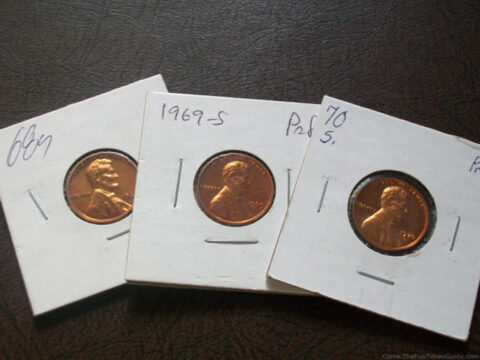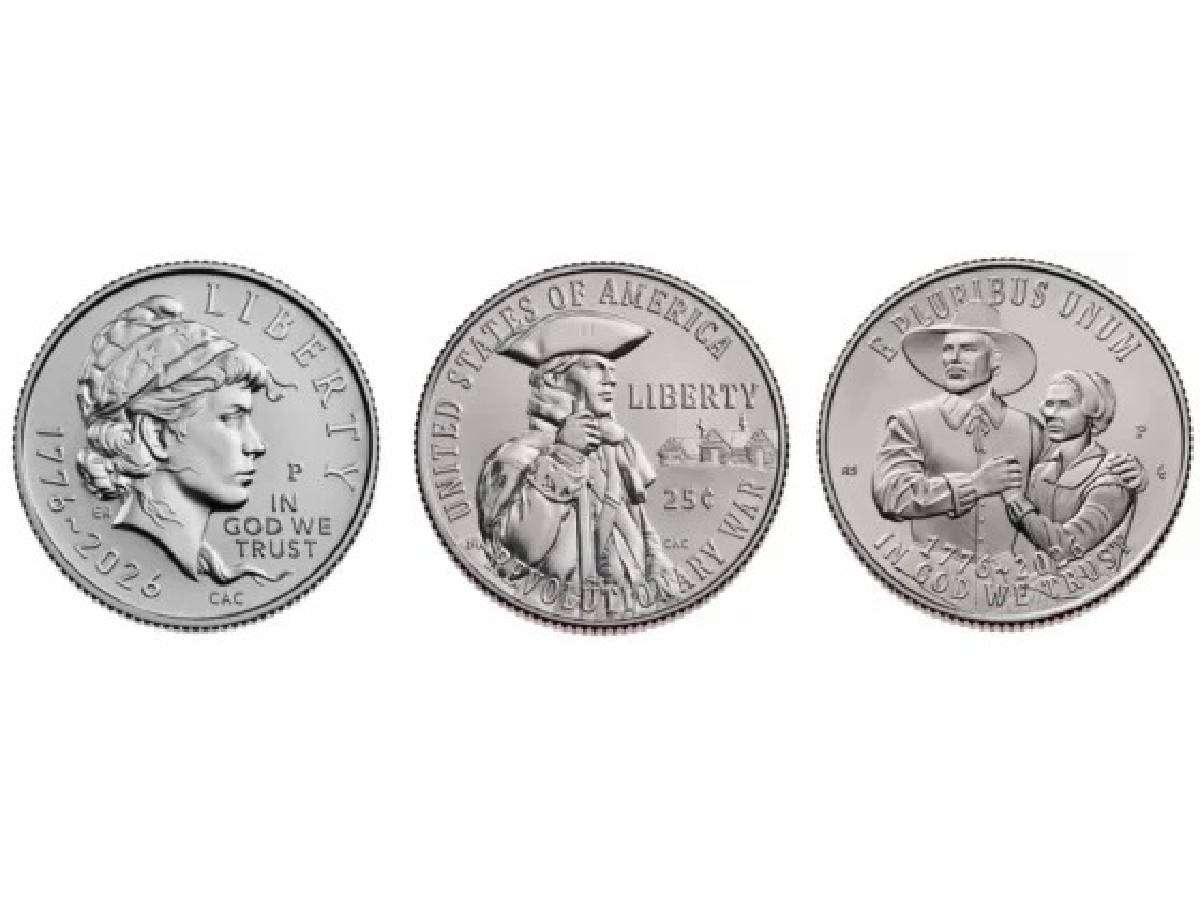
Many people seem to assume that the older a coin is… the more valuable it is.
I mean, right? The older something is the rarer and more valuable it must be… Or so goes the seeming logic of many people who ask me questions about their coins.
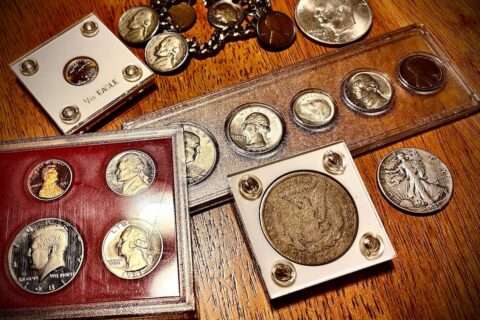
OK, OK… I get the line of thinking there. I really do.
On the surface it makes sense with two coins — perhaps one from the 19th century and another from the 20th century — that the older coin would automatically be worth more than the newer coin.
But the dynamics behind coin values just aren’t that simplistic.
Coin values are based on several factors that I’m going to explain more about in this article.
Beauty Before Age?
When it comes to coin values, age is far less important than other factors.
In fact, in many (if not MOST) cases, the age of a coin is totally irrelevant to determining its value.
What’s far more important in valuing coins is:
- How rare or “in demand” they are
- Their metal content
- Their condition (how they look)
Beyond the basis of rarity or metal composition, the grade and “eye appeal” are often the biggest determinants in the value of any coin. I’ll talk more about this in a minute.
4 Factors That Affect Old Coin Values
Curious what factors are used to figure out how much a coin is worth?
Here’s a look at some of the variables that go into coin values…
#1 – Rarity Versus Demand
Take just about any commodity and you’ll see that its pricing is largely dictated by the laws of supply and demand. That’s certainly the case with coins!
Just because a coin is old — or even had a very small mintage — does not always mean it’s going to be worth a lot of money.
I like to illustrate this point using some very popular, valuable, and rare coins…
Consider the 1909-S VDB Lincoln Wheat penny, which is easily one of the most well-known coins around. The U.S. Mint struck 484,000 examples of the 1909-S VDB penny, and it’s fair to say that’s a small number of coins. Some resources, like Professional Coin Grading Service (PCGS), suggest that only 50,000 specimens may still exist today.
Now, a coin with only 50,000 survivors is scarce to be sure. And when you consider that potentially millions of people who fervently (or even casually) collect Lincoln pennies WANT one. (In fact, they NEED one if they’re attempting to build a complete set of Lincoln pennies!) It makes sense that a typical 1909-S VDB penny is worth at least $700 to $800 in lower circulated grades.
But, wait… There are many coins that are far older and rarer than the 1909-S VDB Lincoln penny that can be had for a fraction of the price of the famous and valuable 1909 penny.
Consider the case of the 1849-O Liberty Seated half dime, a small and relatively obscure silver coin in the eyes of most coin collectors. It’s the type of piece that’s pretty cool to hold in your hands — and it predates the American Civil War. The 1849-O Liberty Seated half dime had a mintage of 140,000. Yet, PCGS estimates just 200 still exist. And, guess what? You could buy an example in a well-worn grade of Good-4 for about $200!
Yes, you read that correctly: You can own a rare, pre-Civil War silver coin with maybe 200 in existence for perhaps 25% of the price you’d pay for a 1909-S VDB Lincoln penny.
Why does the much older, significantly rare silver coin have a lower value than the 1909-S VDB Lincoln penny? It’s all about supply and demand. You’ll have a much harder time finding an 1849-O Liberty Seated half dime for sale than you will a 1909-S VDB Lincoln penny.
Attend a major coin show and you’ll probably spot 100 examples of the 1909-S VDB penny. However, you might be lucky to find one or two of the 1849-O Liberty Seated half dimes in any grade. But guess what coin has legions of fans chasing it down? And guess which one most collectors don’t even know exists?
Yep, there’s your answer. Supply and demand…
#2 – Bullion (Or Metal) Value
The value of the metal inside a coin is often a huge determinant of its value, and this is often what makes or breaks a coin’s value.
While old copper or nickel coins might trade for a few bucks here and there, take a gold or silver coin of any vintage (it doesn’t matter how recent a coin we’re talking) and if it has high-purity precious metals in it, it’s going to be worth a pretty penny.
While bullion values aren’t always the only dictator of a coin’s value, they certainly can have an outsized influence on what a coin is worth. This is especially true when the coin in question is otherwise common or not of an exceptionally high grade.
For example, during the mid-2020s, when the price of gold ran past $2,500, eclipsed $3,000, and even broke $4,000 per ounce…
- It was possible to buy a classic 90% gold 1920s Saint-Gaudens $20 gold double eagle (with about 0.9675 ounces of gold) for prices right around its spot value.
- However, a modern-day 91.67% (or 22-karat) $50 American Gold Eagle, which has a full troy ounce of gold and are frequently more common, regularly traded for $50 to $100 above its melt value.
Why?
One reason is because many gold investors prioritized the easily tradable coin, with a full ounce of higher-purity gold, versus a classic coin whose gold purity was also high but not quite 22 karats.
#3 – Condition, Eye Appeal & Grade
Sometimes it’s all about looks, or so goes the case with coins. It’s generally the case that a high-grade (lightly circulated or uncirculated) coin will be worth more than that same type of coin in a lower grade.
And that makes sense, right?
I’d argue that a really pretty-looking coin in top condition should always be worth more than one carrying extensive wear. But then again, there’s a case to be made about the challenging and exciting world of collecting low ball coins, but I digress.
It’s further the case that a coin with an especially strong strike, pleasant toning, or other positive subjective characteristics will rank better in the marketplace than a coin that lacks these qualities — even if both coins are the same technical grade!
And this goes for coins of any age, any vintage.
#4 – The Presence Or Absence Of Errors & Varieties
So many coin collectors love to find coins with mint mistakes like errors and varieties. Sometimes these mistakes are drastic.
Examples of drastic errors and varieties:
- Mismatched (or muled) heads-side and tails-side designs on the same coin — like some 2000 Sacagawea dollars that show the head of a Washington quarter
- Doubled die coins worth money — like the 1955 and 1969-S doubled die pennies
- Major off-center errors with at least 50% of the design missing
- Valuable off-metal transitional errors — like 1943 copper pennies, 1965 silver dimes, and 1965 silver quarters
Incredible errors and varieties like these mentioned above are almost always worth big bucks, regardless of their date or age!