

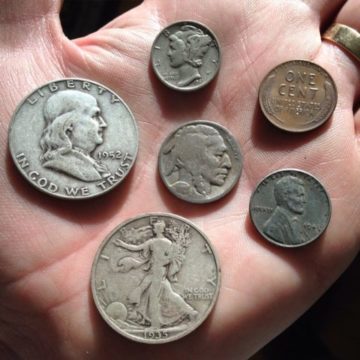
Even though many coin collectors can’t afford to purchase rare coins, numismatists of every budget still like to know which are the rarest coins.
Of course, like so many things, rarity is a matter of relativity.
In certain cases, many coins that collectors consider rare are, in absolute numbers, rather plentiful.
Even certain coins that have been minted well into the thousands are still considered rare because there simply are nowhere nearly enough coins of certain dates available to satisfy all coin collectors’ demands!
While there are simply too many different kinds of rare coins to consider here, let’s look at 9 of the rarest coins many coin collectors love to chase after.
The Top 9 Rarest U.S. Coins
Again, there are many, many different types of coins that collectors, numismatists, and others consider rare.
But let’s look at 9 of the most popular rare coins that are always in demand…
1909-S VDB Lincoln Cent
Perhaps the one coin both coin collectors and non-collectors know a lot about is the 1909-S VDB Lincoln cent.
While 484,000 were made (and thus, there really are many of these coins around), there are simply way too many more people who want this coin than there are remaining specimens.
Values have risen considerably in recent years.
It has now gotten to the point where you can expect to spend about $1,000 for even a well-worn example that hasn’t been cleaned or damaged.
Uncirculated specimens are worth around $2,000 to $3,000 and up.
People will shell out hundreds of dollars even for corroded examples of this famous coin! Just beware of what you’re buying. There are many more fakes, replicas, and bogus 1909-S VDB pennies than there are real ones, and therefore you can protect yourself by purchasing a slabbed version of this coin.
1943 Bronze Lincoln Cent
The U.S. was making steel pennies in 1943 to save copper for the war effort.
But… The US mint apparently still had some copper coin blanks on hand when they accidentally minted about 40 bronze examples of the 1943 cent.
The 1943 bronze cent has shown up in circulation on extremely rare occasions over the decades.
All examples are extremely valuable, bringing in around $125,000 or more in recent years.
How can you tell if you have a real 1943 bronze penny? There are actually two ways:
- See if it sticks to a magnet — If your 1943 penny sticks to a magnet, it’s NOT a real 1943 bronze penny, since copper doesn’t stick to a magnet. If your 1943 penny does not stick to a magnet it may be the real thing.
- Find out what it weighs — Use a good coin scale to check the weight of your 1943 penny. If it weighs between 2.9 and 3.3 grams, it may be a bronze penny.
Even if your 1943 penny seems to check out as bronze, it’s still worth getting it authenticated, since so many apparent 1943 copper pennies end up being merely altered 1948 pennies or copper pennies of other dates that have been manipulated to appear like a 1943 bronze penny.
1913 Liberty Nickel
While not a regular-issue coin, the 1913 Liberty nickel is the stuff of some coin collectors’ dreams.
Just 5 of these coins were made, and by every measure it seems these coins were struck surreptitiously. Yep, it seems the 1913 Liberty nickel wasn’t even authorized as official coins. They were likely produced under clandestine circumstances. Still, that doesn’t dissuade collectors. In fact, the spurious background of the 1913 Liberty nickel only adds to the mystique of this incredible rarity. And on the rare occasion that these trophy nickels happen to go to auction, they draw big-time attention and sell for ever-increasing amounts.
One 1913 Liberty nickel sold for $4.56 million!
1916-D Mercury Dime
The 1916-D Mercury dime is a rarity along the same lines as the 1909-S VDB Lincoln cent.
This is a key issue for collectors of the series.
There were 264,000 1916-D Mercury dimes struck. But, why were so few of these dimes made? It’s mostly because the Mercury dime didn’t come along until late in the year, and the Denver Mint didn’t even strike the 1916-D Mercury dime until December, chronologically limiting how many could be struck. What’s more, Denver was focused on minting the quarter, diverting time and resources from striking the new dime.
There simply aren’t enough 1916-D Mercury dimes to go to all the coin collectors who want them!
Buying a 1916-D Mercury dime means paying at least $1,000 (more or less) for an example that’s well worn but not damaged. Do yourself a huge favor and buy a slabbed example, since so many coins that appear to be 1916-D Mercury dimes end up being counterfeits or altered hacks.
1901-S Barber Quarter
The 1901-S Barber quarter has long been a sought-after coin for collectors.
However, this one eludes many collectors due to its high price and relatively low mintage — only 72,664 were made. Of course, this begs the question: why were so few 1901-S Barber quarters struck?
For starters, the United States Mint churned out tons of Barber quarters in 1901 — but mostly at the Philadelphia and New Orleans facilities, where 8.8 million and 1.6 million were respectively produced.
San Francisco was mainly busy making gold coins in 1901. This hampered how many quarters were struck at the City by the Bay that year. Combine that with the fact that relatively few collectors were saving contemporary S-mint quarters in the early 1900s, and the rarity of the 1901-S Barber quarter makes even more sense.
Values range between $5,000 and $20,000 for well to moderately circulated examples.
1916 Standing Liberty Quarter
The 1916 Standing Liberty quarter is popular for many reasons.
For one, this coin had a very low mintage of just 52,000. So few were made as the coin didn’t make it into production until the year was almost over. Millions of strikes came in 1917, rendering those coins much more common than their 1916 counterparts.
And while the 1916 Standing Liberty quarter is popular because it was the first year of the new design, it’s also widely collected because of its controversial motif showing a bare-breasted Miss Liberty.
In 1917, the U.S. Mint provided Miss Liberty a mail that covers her front and also a redesigned reverse that changes the placement of the stars around the flying eagle.
Values for the 1916 Standing Liberty quarter range from $5,000 to $7,000 for low-grade examples that are uncleaned and undamaged.
1804 Draped Bust Silver Dollar
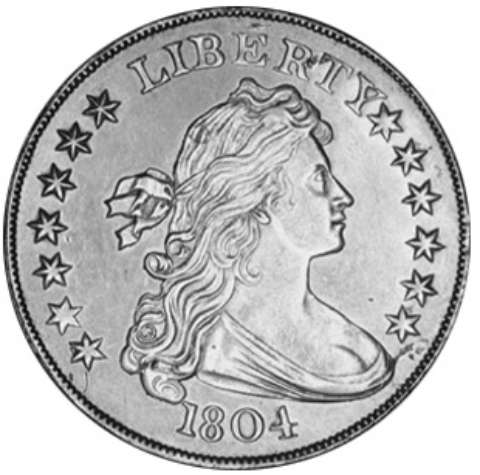
OK, if you want to hear about what’s considered the most popular of all rare coins perhaps in all the world… Then you need to hear more about the 1804 Draped Bust dollar.
Considering both originals and U.S. Mint-made restrikes, fewer than two dozen examples have been struck. For generations, it was long thought that only 15 specimens across three different design and strike types had been made. At least, that was all that was known by the general public. Headlines were made when a 16th example came to light in 2025.
Do even more exist? Do you have the 17th example?
No matter how many 1804 Draped Bust dollars exist, the key fact is that these 1804-dated coins were not struck in 1804. They were first made in 1834-1835 and were included in special presentation proof sets given to foreign heads of state as diplomatic gifts.
If you want an 1804 Draped Bust dollar for your coin collection, you’ll need to have some cash on hand, because you’ll have to spend well over a million dollars to get one!
In fact one sold at auction in 2021 for $7.68 million.
1893-S Morgan Dollar
Though not worth millions like the 1804 dollar we just discussed, the 1893-S Morgan dollar isn’t any slouch!
Only 100,000 were made, and putting one of these coins in your collection may mean saving up some funds for a while first. The mintage of this coin was low to begin with, but what compounds the rarity of the 1893-S Morgan dollar even more is that so many examples saw heavy circulation wear. Only a fraction of the 100,000 were saved by collectors, with some estimates putting the number of survivors at about 10,000 across all grades, or about 10% of the entire mintage. On top of that, the vast majority of survivors experienced heavy circulation wear.
The 1893-S Morgan dollar costs over $7,000 in grades of Very Fine.
Get ready to spend over $400,000 if you want an example in nice uncirculated examples.
1933 Double Eagle
OK, we’re saving the most-expensive of the 9 coins here for last.
The 1933 Double Eagle gold coin is not only a rare coin, but it belongs to a series that’s widely considered among the most beautiful coins in the world.
The Saint-Gaudens double eagle, named for its designer (Augustus Saint-Gaudens), was produced from 1907 through 1933.
During the last year, 445,000 were made but virtually all were melted by the U.S. Mint because of a gold recall that was announced on April 5, 1933. President Franklin Delano Roosevelt had signed Executive Order 6102 into law, which prevented gold hoarding by private citizens and calling for Americans to send their gold into the government at a then-fair rate of $20.67 per ounce. The goal? To back the production of more money (when US currency was still backed by gold) to help enact programs that would employ Americans and support the nation’s economy during the depths of the Great Depression.
In light of the gold recall, the United States government ceased production of gold coins and intended for all 1933 Saint-Gaudens double eagles to be melted — with the exception of two examples to be preserved in the National Numismatic Collection at the Smithsonian.
Some examples did escape into private hands, and about a dozen of these coins are known to exist. However, only one has been deemed legal for private collectors to own. This example sold for $18.9 million at auction in 2021 to become the most valuable coin in the world!


