

Some 1982 pennies were made with copper. Others were struck with zinc. You can use a scale to easily tell the valuable bronze 1982 pennies from the zinc ones. But…
What if you don’t have a coin scale?
This trick makes it EASY to identify 1982 copper pennies from 1982 zinc pennies with NO scale! (Use at your own risk.)
⚡TIMESTAMPS⚡
00:00 Intro: Copper vs Zinc Penny Differences
01:26 Official Weights For 1982 Copper vs Zinc Pennies
02:44 Other Ways To Tell Zinc From Copper Pennies
03:24 Mint State Grade Of Coins Explained
04:01 Bronze / Copper Penny Sound To Listen For (“Ring”)
04:28 Zinc Penny Sound To Listen For (“Click”)
05:59 Do This Test At Your Own Risk!
06:23 Summary: Copper vs Zinc Penny Differences
07:05 When To Use This Tip For 1982 Pennies
============================
TRANSCRIPT:
Hey, this is Josh with the U.S. Coins Guide and today we’re going to talk about how to tell a 1982 copper (or bronze) penny apart from a 1982 zinc penny.
There are ways to tell the two apart WITHOUT using a scale. I’m going to show you how to do that, too. So, stay tuned!
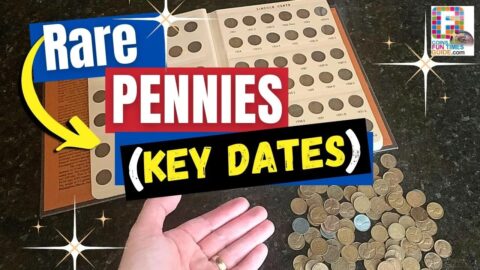
So, here is my beloved Lincoln penny collection. You may have seen this Dansco album before if you’ve watched a few of my videos here in the US Coins Guide.
Usually, it’s where I start off… or finish off… or oftentimes will culminate my videos with a talk about Lincoln pennies or some related topic. And today is no exception.
We see here the 1982 department of my Dansco album. And you might see there are two coins missing from it: the 1982-D large date copper and 1982-D large date zinc.
Now, the size of the date really is inconsequential to this video. It’s more about the fact that one is copper and one is zinc that I want to focus today’s video on.
And we see these two coins right here… the 1982-D large date copper and 1982-D large date zinc.
So, what’s going on? Why are these two coins out? And how do you tell the copper 1982 penny apart from the zinc 1982 penny?
Well, there are ways to tell. And as I’ve discussed before in other videos and other articles here at the US Coins Guide, it often comes down to the scale.
The copper pennies have a spec weight of 3.11 grams. Whereas the zinc weight is generally 2.5 grams.
Now, there are tolerances in there. And in many cases, you might find a 3.0 or 3.2 gram copper penny that is within variables within tolerance. And you might find a 2.4 or 2.6 gram penny that is, again, within tolerance.
It’s not really an unusual finding to come across a slightly overweight or underweight coin — and that includes pennies. Just to show you here… Here is the copper 1982 penny. I put on the scale and you’ll see that it comes out to a weight of 3.1 grams. Not unexpected! It’s exactly what you would expect to find when you’re weighing a US one cent coin.
Here’s the zinc penny… 2.6 grams! That kind of explains my point about how you get a little bit of under or overweight planchet sometimes — but within spec, within tolerances. So, 2.6 grams.
So, it’s great IF you have a scale… telling apart 1982 pennies. I mean, you just pull the scale out, you get some coins, start weighing them.
But what do you do if you don’t have a scale?
Well, I have heard from other coin scholars over the years that there are ways you can tell a copper penny apart from a zinc penny. And it comes down to not so much the weight per se, but how the coin SOUNDS when it hits a hard surface like a table.
This is a hard wood table. And I have tested out the tip I’m about to show you. It’s been said that a 1982 copper penny (or really ANY copper penny) will make a slight “ringing” sound when it hits a hard surface like a wooden table.
Whereas a zinc penny makes more of a “clicking” sound when it hits a hard surface. And I want to show you how that works.
Now, these are Mint State pennies from my album. I am NOT going to drop these two coins on this table to demonstrate the sound of the copper versus the sound of the zinc — because that would ruin / damage these coins and I don’t really want to ruin my collection to demonstrate the sounds these coins make.
But you know what? I have plenty of other circulated or lower value coins in my pocket change and in my ancillary collection I can use for this purpose.
So, let’s go ahead… Put our listening ears on, if you will. And let’s see how this 1957 Denver bronze (or copper) penny sounds when it hits the table.
Ready?…
You hear that? Listen carefully. Listen carefully…
Hear that ring? That right there.
One more time…
Hear that?
Alright, let’s take this… What is this?… That’s another bronze. Let’s take this… I know this is for sure a zinc. This 2005 Lincoln cent. And listen to how it sounds when it hits the table.
Hear that?
Click!
Click!
Click!
Click!
Again, the bronze…
Hear that?
That distinctive little chime versus the zinc.
THAT is how you can tell apart a 1982 copper penny from a 1982 zinc penny.
If you drop a 1982 penny on a table (we’ll say) and it makes a RINGING sound, it is a bronze or copper penny.
And if you drop a 1982 penny on the table, and it makes a CLICKING sound, it’s a zinc penny.
Now listen… (Ha! No pun intended.) There ARE times that your ears might deceive you — and you might in fact drop a bronze penny and it might sound to your ears like a click.
And there are times you might get the opposite effect with a zinc penny — you might perceive a little bit of a ring in there.
But if you’re listening correctly, and you are dropping the coin on a hard surface and there’s no other aural distractions around you to make your ears hear things that probably aren’t there… you’ll be able to tell a 1982 copper penny from 1982 zinc penny just by dropping on a hard surface like a table and listening for the sound.
Again, a bronze or copper penny makes a ringing sound (like a chiming sound), and a zinc penny makes a clicking sound.
Now, of course, I do this video with the disclaimer that you might damage your coins in the process of dropping them on a table or a hard surface. So, I’m not responsible for any damage that occurs to your coins if you use a “drop test” to tell apart copper versus zinc pennies.
But, if you’re in a pinch, have no scale, and want to know if you have a 1982 copper or ’82 zinc penny, that is how you tell. The ol’ trusty “drop test.”
And that is how you tell the 1982 copper penny apart from a 1982 zinc penny!
It’s all about the sound they make when you drop those coins on a hard surface like a table.
Again, a 1982 copper penny makes a “ching” or a “ring” sound or something approximating that noise. And then a zinc penny makes a little “click” — a little dull click sound when it hits a table or hard surface.
But, I want to advise you once more… this is to be done only at your own risk. Nobody with the US Coins Guide channel, including yours truly, assumes any responsibility for damage on your coins if you drop them on a hard surface. Because doing so can, in fact, impart damage to your coins.
You might ask, “Well, when do you use this tip?”
When do I use it? I use it when I’m in a pinch. I don’t carry a coin scale with me when I’m out and about. But I do use cash sometimes for transactions. And I will come across a 1982 penny in change. And I’ll want to know if it’s copper or zinc or worth saving or worth spending.
And when I’m also going through coin rolls and I come across 1982 pennies.
Usually, I have a scale with me. But there are times that I don’t. And that’s when the “drop test” again comes in handy.
So, use it again at your own discretion… at your own risk. But I hope it does help you determine copper versus zinc pennies — especially those from 1982, which could be either or!
Let me know in the comments below what you think about this test. If you’ve tried it and if it’s worked for you. Or if you’ve tried it and you just can’t tell the “ring” from the “click” — I want to know. I might be able to help you out.
I do try to answer questions here on the US Coins Guide channel where we have MANY videos on a range of topics about numismatics. So please check those out. And give us a “thumbs up” or a “share” on videos that you enjoy and want to spread the word about.
But in the meantime, this is Josh with the US Coins Guide thanking you for your time. And happy collecting!