
Do you know how 1955 doubled die pennies were made? Or why they even entered circulation in the first place? Find out in this video!
⚡TIMESTAMPS⚡
00:00 Intro about the 1955 double die penny
00:18 One of our subscribers (Paul) requested this video
01:33 How many 1955 pennies were made
01:44 How 1955 double die pennies came to be
02:26 A Guide Book of Lincoln Cents shows exactly what type of doubling look for
02:58 How many 1955 double die error pennies were made
04:01 This error penny was distributed with vending machine cigarettes
05:10 These error pennies were released during a boom time for coin collecting in the 50s
05:35 Values for 1955 doubled die pennies in the 1950s
05:56 Values for 1955 doubled die pennies in the 1980s
06:03 Values of 1955 doubled die pennies today
07:02 Collectors today actively search for the 1955 double die penny
07:23 With the U.S. penny going away, more people are looking through their pennies CARD HERE!
07:48 Recent sales prices of the 1955 double die penny today
10:48 Where to find 1955 double die pennies for face value
============================
TRANSCRIPT:
Hey everybody! This is Josh with The Fun Times Guide and today we’re talking about the STORY of the 1955 doubled die obverse penny.
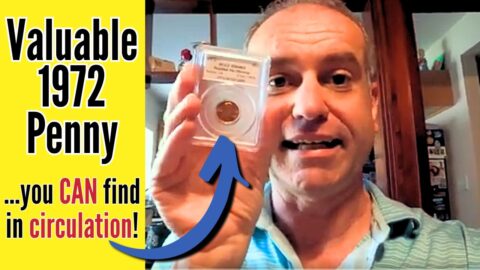
Now I want to say first of all… We have thousands of subscribers — including many of those who are regular viewers of this channel. And one of them, Paul (Hi, Paul!) suggested we talk about the story behind this incredible and popular variety. As we see right here… the 1955 double die obverse penny. Hope you can see it. Ah, there it is!
That’s the coin we’re talking about today. The story behind how this coin got created, why it became so popular with collectors, and what it’s worth. So, stay tuned.
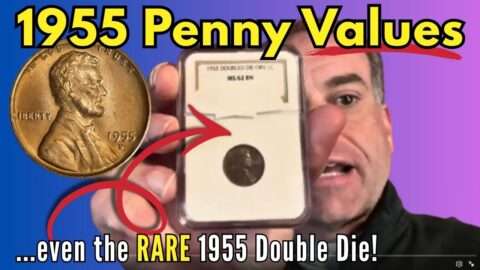
So, we have here a 1955 double die obverse Lincoln cent. This one’s graded MS62 Brown. So, in other words, it’s a lower end uncirculated example with brown surfaces. Brownish surfaces. So, you can tell there’s a little bit of a hint of color in there. Some reddish. But it’s basically a brown designation because it’s a brown Lincoln cent.
And I want to talk about the value of these coins today. But I first want to talk about the STORY behind this coin!
I’ve got to tell you… I mean, these varieties like this double die obverse Lincoln cent are very popular with collectors. I think that’s why our viewer Paul was spurred on to suggest that we talk about the story behind this coin.
And it really had a most ordinary origin. It started off at the Philadelphia Mint as one of over 330 million Lincoln cents struck at the Philadelphia Mint in 1955.
And as happens sometimes, the dies that strike the image on the coin — which would be like in this case (the obverse here) would be the bust of Abraham Lincoln. And on the reverse are the two wheat stocks that kind of encircle the words One Cent, United States of America, E Plurius Unum.
One of the obverse dies was basically impressed (or hubbed) twice at different angles. And what that did was it created… I don’t know if you can see it here on this example at this distance. But you can probably tell there is some doubling here on the date, the legend Liberty, and the motto “In God We Trust.”
I actually have a book here. This is… This is a Guide Book of Lincoln Cents. I bought this in probably 2009. So this is an older edition. There are many. There’s at least two others as far as I know that have been made since this time — newer editions. But it does show you some of the details here of the doubling.
We have here, of course, the date. Look how DRASTIC that doubling is! And then here in this inset, we see the doubling in “Liberty.” And “In God We Trust.”
So essentially, these odd-looking Lincoln cents were produced by accident at the United States Mint in Philadelphia. Perhaps 40,000 were actually run off before Mint workers realized that there was an issue with the obverses of their ’55 Lincoln cents.
Mint operators had the option to go ahead and either discard the entire batch of doubled Lincoln cents that were mixed in with regular Lincoln cents — or let them go. Well, the decision was that because this was an error, Mint officials in those days did not think this would garner any kind of attention from collectors — because they were effectively defective coins in the eyes of the Mint operators.
And thus about 24,000 of these doubled Lincoln cents were released in the batch of regular Lincoln cents. And they got basically dispersed into circulation mostly in the northeast. A lot of these coins were found in Massachusetts and surrounding areas in New England.
A lot of these coins were actually packaged in pairs in 23-cent packs of cigarettes that one could buy from a vending machine back in those days. Maybe some of you remember these machines. I actually remember when I was really young. But there were machines where you could actually buy a pack of cigarettes.
And at the time, in the mid-50s, they were about 23 cents apiece. Well, to be able to render change to those who bought those cigarettes and could only use quarters to buy the cigarettes, the cigarette manufacturers packaged two pennies (or one-cent coins) in the cellophane of the 23-cent cigarettes. So that when you put your quarter in the vending machine, out would pop a 23-cent pack of cigarettes and two… basically two pennies as your change in that pack of cigarettes! Right?
Well, a lot of these doubled dies wound up in packs of cigarettes that were sold in the Northeast and New England. And, therefore, a lot of these double die pennies were found in those cigarette vending machines.
Although some turned up in regular circulation. And some came around a lot later on as they filtered into circulation. But the long story short is… these coins serendipitously were created during a boom time in numismatics in the United States.
Millions of people were collecting coins in the mid-50s through the early 60s. And how wonderful it was that this incredibly drastic error happened to be born at a time when so many people were looking for coins in their pocket change to collect!
By the early 60s, these double die obverse Lincoln cents were worth over $10 a pop. Which in those days, folks… that’s a lot of money in the early 60s! For basically a defective penny.
And the incredible popularity of this coin just grew and grew from there. By the early 80s, this coin was worth $300 to $400 bucks. And it has only gone up in value since then.
Today, in the mid 2020s, a coin of this condition here (we’ll say, low and uncirculated) is worth $3,000 to $4,000. A better condition circulated example is worth $2,000 to $3,000, based on if it’s XF to AU.
If this coin were let’s say MS63 and instead of brown (or BN) it was MS63 RB (B as in boy, or “red brown”) this would be worth $4,000 to $5,000. And an RD (D as in dog)… If this coin were MS65RD it could easily sell for between $9,000 and $11,000. And that’s again in the mid-2020s. It could be worth a lot more by the time you watch this video.
Long story short, this coin due to its drastic doubling, the fact that it arose during one of the most fervent times in the hobby’s history in the U.S., and the fact that collectors to this day still demand this coin…They want this coin for their collections. And let me tell you folks, there are tens of thousands of people who collect Lincoln cents ardently and WANT an example of this coin!
Therefore, there’s a reason why this coin is NOT worth what it is — and it could be worth a whole lot more down the pike. As now with the penny coming to an end in circulation, more eyes are on the one-cent coin and there are a lot of folks who want to build sets of Lincoln cents — and they want ALL the varieties and errors including (and perhaps most principally) the 1955 double die obverse Lincoln cent.
I want to show you guys here — just so you see what’s going on with values. Let me go ahead and get back on my computer here, which happened to turn off while I was talking to you.
I want to give you kind of a rundown here on recent sales prices — just so you can see. I want you to visualize the value behind this coin. I’m not just throwing out numbers. I never do that. I always have plenty of comps or auction prices realized or market prices that I go by when I provide values.
Now look at this here… We have an MS64 red. $10,500, guys! Look at that right there. Here is an AE53 PCGS holder… almost $2500. Again, some of these values are outliers. Sometimes you get folks who are looking at one example, and they’re vying for that one example. Or you get a piece that’s just like ultra premium condition, therefore is worth more than like book value. But long story short, these are valuable coins and they’re ALL worth at least — AT LEAST — $1,500 to $2,000 or more in today’s marketplace.
Some here have a little bit less. But this one’s “cleaned” right here — so, therefore it has a lower value. As does this one over here. It says “corrosion removed, genuine” — so this coin has had some work done on it to kind of give it a more presentable appearance. But again… I mean, look at this! This is well over $1,000!
And most of them are worth between $2,000 to $5,000. You get some like this one here. This is a VERY nice example of an MS64 red. It sold for $15,000!
You get the idea. These are valuable error Lincoln pennies and they are worth a pretty penny. Also, I want you to know that… Again, as I said, this video was inspired by a comment that we got here on the U.S. Coins Guide on YouTube.
We receive so many comments from people just like you with questions about your coins — or suggestions of what you want us to cover. And I hope that this goes to show that we actually not just appreciate comments, we actually read our comments and respond to them and are inspired ourselves to create videos based around your suggestions and your ideas.
So please drop your comments! If you have any ideas about something you want to see us cover when it comes to coin collecting here on the YouTube channel or on Coins.TheFunTimesGuide.com, let us know! We read every comment. And we definitely take heed to those that we can be able to follow up on with either videos like this one or articles on Coins.TheFunTimesGuide.com
As we go through these values here, folks… I mean, it’s amazing what these coins are worth! So, it begs the question, do you have a 1955 double die penny and want to know what it’s worth? Let us know below.
Do you like these coins? Do you have one? Or do you want to buy one? I’d be very curious about that. You can always drop a line and let us know if you either have a ’55 double die Lincoln cent or you hope to purchase one someday — or maybe even find one for face value in circulation which does happen.
People can find these coins in old bank rolls. But I mean, again… We’re going down this pike here on Heritage Auctions (or HA.com) and these values are just incredible. And it goes to show this is one coin worth looking for!
And there you have it folks. That’s the BACKSTORY on the 1955 doubled die obverse Lincoln cent. A coin I certainly enjoyed talking about — as this video I guess helps to evidence.
And one, I want to thank our viewer Paul for reaching out about some time back with his comment he left for us on another video here at the U.S. Coins Guide. We have many videos and articles that cover 1955 penny values — so check those out.
If you have any questions about your Lincoln pennies or topics you want to see us cover here at the U.S. Coins Guide YouTube Channel or at Coins.TheFunTimesGuide.com, let us know.
In the meantime, I appreciate you watching this video. Please give us a thumbs up if you can. Or like and share this video, subscribe. We cover ALL kinds of topics about U.S, numismatics as well as other coin related subjects.
So, thank you for watching this video. And happy collecting!