



The 1922 Plain No D Penny is one of the most popular Lincoln cent errors. Here’s how it came to be + How much it’s worth today!
⚡TIMESTAMPS⚡
00:00 Intro about this RARE error coin
00:11 A 1922 Plain Penny is NOT a Philadelphia Mint coin
00:45 The 1922 Plain Penny in my Lincoln cent album
01:33 Why the 1922 Plain Penny is REQUIRED in coin albums
02:35 How people reacted in 1922 regarding this penny
03:13 How many 1922 Denver pennies were made
03:37 How the 1922 Plain Penny came to be made (and why it’s RARE)
04:33 All 1922 Plain Pennies have a worn looking obverse & sharp looking reverse
05:20 EXAMPLE: This 1922 Plain Penny is graded “Good 4”
05:54 1922 Plain Penny values
06:43 The lowest price you’ll find a 1922 Plain Penny for today
07:00 Why you should only buy a “certified” 1922 Plain Penny
07:19 1922 Weak D Penny vs 1922 Plain Penny
07:37 Details to look for on legit 1922 Plain Pennies
08:40 Yes, you can find a 1922 Plain Penny in circulation
08:56 Best places to find a 1922 Plain Penny
10:03 Before you buy a 1922 Plain Penny, do some research first
10:54 Summary of the key points & takeaways
============================
TRANSCRIPT:
Hey, this is Josh with the US Coins Guide and today we’re talking about 1922 Plain (or “No D”, as in “No Denver”) pennies.
Now, what’s a 1922 Plain No D Penny?
Well, I’ll tell you what it’s NOT… It is NOT a Philadelphia strike.
Now, you’re probably going, “Wait a minute. This penny has no mint mark. It’s GOT to be a Philly strike!”
At least in most cases, that’s what you typically would expect with a coin with no mint mark. But as a matter of fact, this very much branch mint penny has NO mintmark due to a very rare and very cool error variety.
I’m going to tell you all about that variety, what this 1922 Plain No D Penny is worth, and how you can maybe find one! So stay tuned…
So we have here a 1922 Plain Penny. This is in my Lincoln cent collection. I have been building this set out for many, many years now. Going back almost 20 years since I first bought this Dansco album.
And my gosh, I really really enjoy my Lincoln pennies. As you can see, it’s probably the one set (along with my 20th century set, which I’ve done a video about also here at US Coins Guide) that I’ll ALWAYS keep. Because it goes right back to the very root of my collecting journey. I’ve ALWAYS enjoyed Lincoln pennies.
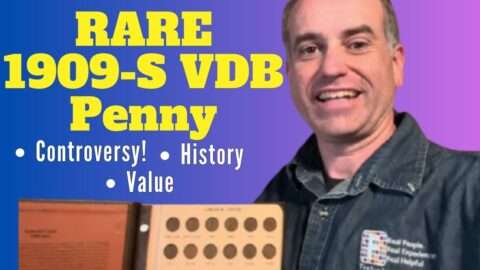
Now, when I first got involved in the hobby though, there are a few coins I couldn’t afford — like the 1909-S VDB Lincoln Cent right here… the 1914-D Lincoln Wheat Penny (another rare date)… and then, of course, the 1922 Plain Penny.
Now, I always wondered why it was that this coin became such a popular commodity in the hobby. Because after all, it’s a variety. And a lot of times varieties are not really included in typical date & mintmark runs like we see here.
My gosh. I mean, even the ever popular 1955 Double Die Penny, which is probably one of THE key dates in the whole collection of Lincoln cents, is not included in this Dansco album.
So, when I first bought this album many, many, many, many, many years ago, I wondered, “I mean, why is this coin so important? It’s not even really a regular production. It wasn’t a regular issue.”
I even went so far as to write an article about this coin. You can find it at https://Coins.TheFunTimesGuide.com/1922-plain-penny-error/
I did a commentary about why is the 1922 Plain Penny so important to the Lincoln cent cannon? And why is it that many albums and folders REQUIRE it to complete the album?
Well, it really goes back to the very beginning of when this coin was first discovered. At the time when it came out in 1922, people were finding these 1922 Plain Pennies and they assumed that it was just a Philadelphia strike.
I mean, look at all of the other Philadelphia strikes here… 1921, 1923… We’ll go back before the ’22 to show the precedent for why people thought it was a Philadelphia strike… 1920.
Look at what’s missing. There’s NO mintmark under the dates of the Philadelphia strikes. So many folks thought it was just a Philadelphia production.
But it soon became clear that there was, in fact, NO 1922 Philadelphia penny!
As a matter of fact, barely more than 7.1 million 1922 Denver strikes were ever made. That was it for the entire run! There were no Philadelphia 1922 pennies. ONLY Denver struck the penny.
So it became evident after that point that the 1922 D Pennies with “no D” must be pretty important!
As a matter of fact, they were. Because they were much harder to find than the Denver strikes!
As it turned out, there were several dies that (or die marriages) that were used in 1922 at the Denver mint to produce its pennies. And one particular set of dies, which began as a regular 1922 “D” die marriage, ended up CLASHING.
Meaning that both the obverse and reverse dies hit each other with no planchet in between. And basically, the dies were damaged in that incident.
So an overzealous Mint employee took it upon themselves to try to remove the damage from the die clash. And in the process inadvertently removed the “D” mint mark from the obverse die… and REPLACED the reverse die with a brand new die altogether.
So what produced the 1922 Plain Penny was basically a polished 1922 die (obverse die) and a brand new 1922 penny reverse.
And THAT’s why all genuine 1922 Plain Pennies have a very worn looking obverse die with basically the first “2” (so the third digit of the date, right?) is weak.
I don’t know if you can see it through my loupe here. Not very well. Let’s see, am I even looking at the right spot on the coin? Knowing me, I probably am not. And I’ll be 14 minutes trying to get this “just right”.
So, I’ll show you on my computer in a minute. But basically the third digit (or the first “2”) is very weak. And the second “2” is stronger. Which would kind of make sense. Because if a die worker (or a coiner) were trying to polish the die, areas closer to the rim (which is raised) would be more protected than areas closer to the field (or the flat areas).
This is just for reference… I bought this coin graded as a “Good 4” coin. So, it looks worn anyway. But even for a Good 4, it looks extra FLAT.
Yet conversely, on the reverse of the coin… look at how STRONG! Look at the details on that reverse. I mean, that’s a pretty nice looking “Good 4”. Not to be self-touting, but that’s not a bad looking “Good 4” reverse.
But yet look at the… look at the… obverse. And again, you can see just how MUSHY it looks.
So, I want to show you here. Just for… just for reference… what these coins are worth.
And we’ll go ahead and go to the Heritage Auctions website over here. I love coming to HA.com. It’s a great place to look up auction archives going back now over over 25 years. You can get a full gamut of auction prices for coins that Heritage Auctions has sold.
And I want to show you the prices here with some of these coins. I mean, look at this! I mean, we’re looking here at $2,300 for a coin sold almost 20 years ago “XF40”.
Here’s one that sold for $23,000 in 2006 “Mint State 62 Brown”.
Let’s see here… I’ll keep on going down the pike here on other auction prices… You see, mostly four-figure prices.
I can tell you that a 1922 Plain Penny in lower grades… basically you can get one for between $500 and $800 for a “Good 4” to “Fine 12” specimen. You’ll pay $1,000 bucks and up for moderately worn examples.
And I always urge you to buy a 1922 plain penny that is certified.
(A) because first of all, you never know what you’re dealing with when it comes to a rarity like this. You could get yourself, by accident, a cast counterfeit or another kind of a fake example.
But also because there were different dies used in 1922. There are at least a couple different known dies that have a WEAK “D”. Which means that if you got close to the coin, you’d see very light traces of a “D” under the date there.
And that’s why it’s important that you know the die markers… you know what to look for. You know, in most cases when you’re looking at a 1922 Plain Penny, you’ll find that the letters in “trust” are pretty sharp, for example. The letters in “we” (W.E.) are kind of mushy.
Again, you’re going to find that the first “2” of the two “2’s” is weaker than the second “2” right there. And again, the reverse is VERY, very strong. I mean it looks razor sharp even though this is a worn specimen. You can you can see some of the wheat leaves there in this “Good 4” specimen.
So those are some die markers there to look for… some die diagnostics.
The weak “D’s” are much more common. Though they are a variety — like this is here. They are common. And sometimes they can masquerade as a Plain Penny. So you’ve got to know what you’re looking for.
I would recommend again that you buy certified examples of the 1922 Plain Penny. Make sure you buy them from a reputable dealer.
And you know, as far as finding these coins in circulation… I mean, you CAN find one in circulation. I don’t think you’re going to find one that looks anything like these coins here, you know. Where we have a “Mint State 53” over here. We have an “AU 53”.
You’ll be hard-pressed to even find a “Good 4” specimen.
Your best bet of fighting a 1922 Plane Penny sort of “in the wild” would be maybe at an estate sale or in an old collection where the person who owns the coin just didn’t know what they had. Or maybe it was passed on down to somebody who doesn’t really know what they’re looking at.
My advice to you is to always be ethical when it comes to buying ANY coin really. Especially if you think that what you’re buying is something worth a whole lot more than what the owner thinks it is.
I’m all for cherry-picking or getting a good deal on a coin that people think is just a regular coin. But be fair. Be ethical. I do think, again, that your best bet is gonna be inheriting a Plain Penny. Or maybe you find one in an old collection.
But then again, I mean, strange things have happened! You can find rare pennies — including 1922 Plain Pennies — with a HUGE stroke of luck through roll searching or bags. But your best bet if you really want to obtain one is just buying one from a coin dealer.
And that’s why I say go to a reputable source. Get it certified. I did crack mine out here many, many years ago to put it in the album.
You get what you pay for, you know. And know what you’re buying. Do your research.
Before I bought my 1922 Plain Penny I went online… I bought books. I have here…
This is one of my very first books I ever bought in THIS series of books, The Official Red Book series. This is the FIRST edition actually of this book. I think it’s in its third edition now. And it’s where I learned about everything Lincoln pennies including the 1922 Plain No D Penny.
So yeah, do your research, buy the book before the coin, and most of all know what you’re buying.
So, I hope this little tutorial… this overview of 1922 Plain Pennies, their values, maybe how you can find one, what they can be worth…
You know, as we see here online through auction archives, these are really valuable rare coins. And I’ll tell you what, they’re pretty cool, too, if you ask me.
And there you have it. That’s a bit about the 1922 Plain (or “No D”) Penny. A coin that’s worth a LOT of money. One I urge you to make sure that if you were to buy… you get it certified so you ensure that you’re buying the Real McCoy.
You could find it in circulation, but that would take a lot of time and probably even more LUCK. So, I urge you just to buy one if you really want to add one to your collection.
But make sure you know what you’re purchasing. Buy the book before the coin — which means to go ahead and buy the actual book (or books) about Lincoln pennies.
Or go online. We have at US Coins Guide a number of videos both on YouTube and on our website where you can find out more about rare coins like the 1922 Plain No D Penny and other rare and valuable wheat pennies.
So please let us know what your thoughts are on this rare coin. Do you have one? Tell us in the comments. Are you trying to find out if you do by chance have a 1922 Plain versus say a Weak D Penny? Drop us a comment below. I can try and help you out and tell you what you might have there.
Go to TheFunTimesGuide.com or UScoinsGuide.com. Or you can leave comments as well. And give us a thumbs up if you think we’re doing a good job here.
So again, this is Josh with the US Coins Guide thanking you for your time and wishing you happy collecting!