We received the following pictures of an unusual looking U.S. nickel from a loyal reader:
Could you please check out this nickel which I found among my other nickels and let me know if it’s an error coin? Your help would be highly appreciated.
— Edwin
Are you curious about this nickel, too?
Wondering how to tell a legit error coin from a coin that’s been damaged after it left the Mint?
Read on to find out…
Is It A Nickel Error Coin Or Just A Damaged Coin?
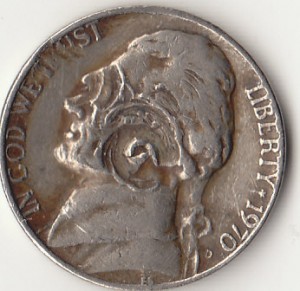
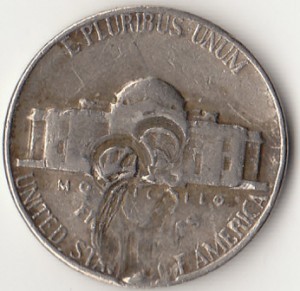
Well, Edwin (and everybody else!) it looks like the 1970 Jefferson nickel in question is the victim of post-mint damage.
Post-mint damage refers to alterations (either accidental or intended) which occur to a coin after it’s been minted.
Thus, this is NOT a valuable nickel error coin.
How Can I Tell That It’s Post-Mint Damage?
In the case of Edwin’s 1970 Jefferson nickel, it looks like it was severely damaged by something exerting torquing (twisting) pressure. Apparently, the nickel got caught or stuck in something with severe pressure.
You can observe some of the damage as evidenced by areas where the metal appears to have been pushed up along the ridges of the gouging.
You can even see where part of the rim on the bottom of the reverse (around 6:00 on the tails side of the coin, below Monticello) is actually broken away.
It looks like the coin saw wear after it was damaged. I can tell because it looks like some of the raised areas of damage have been softened or blunted through wear.
Who knows what caused this post-mint damage, but it certainly resulted in some eye-popping results!
Error Coins vs. Damaged Coins
At this point, you’re probably wondering what an error coin is versus damaged coins.
Generally…
- An error coin is one that was somehow messed up at the United States Mint due to a minting blunder.
- A post-mint damage coin is one that suffered either intentional or accidental alterations after it left the Mint.
Error coins are generally more valuable than regular coins — even if only slightly moreso.
Some of the most common errors and varieties, like some types of off-center strikes or blank planchets are worth only a few dollars. Double die error coins are one of the types of coin errors worth significantly more — like the 1955 doubled die cent, which is worth around $1,000 and up!
Damaged coins are generally less valuable than regular coins — if they have any value at all.
Some of the most common types of coin damage include coins that have been cleaned, coins that have holes, coins that are bent, coins that are corroded, and other coins that have been messed up in one way or another.
The Bottom Line…
While Edwin’s nickel may look pretty off the wall, it unfortunately isn’t worth more than face value. Rarely does post-mint damage ever cause a coin to be worth more.
One of the few instances of post-mint damage causing a coin to be worth more would be Hobo nickels — Buffalo nickels that were artfully re-sculpted.
Definitely keep checking your spare change. Even if you don’t find anything extraordinarily valuable, you may find a conversation piece like Edwin’s 1970 Jefferson nickel!